
Overview
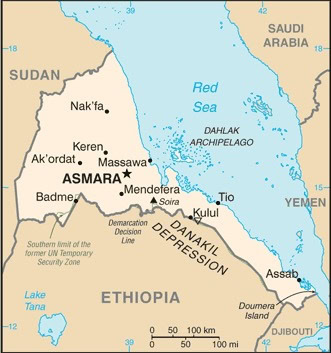
Situated in the Horn of Africa, or Somali Peninsula (as it is also known), the State of Eritrea is a country with a population of just over six million people. Eritrea has a 750 mile coastline on the Red Sea and borders Sudan to the west, Ethiopia to the south and Djibouti to the southeast.
Eritrea gained its independence from Ethiopia in the early 1990s, following 30 years of guerrilla warfare. An Italian colony until the Second World War, Eritrea had been part of a United Nations organised federation with Ethiopia until the latter annulled Eritrea’s parliament and annexed the country in the early 1960s. Independence was formally declared in 1993, following a referendum.
The border with Ethiopia continues to be a cause of tension and a fresh, two-year border war broke out between the two countries in 1998.
Since independence Eritrea has been, effectively, a one-party presidential dictatorship. Isaias Afwerki, who had led the Eritrean People’s Liberation Front prior to independence, has been president since 1993. No presidential elections have been held since. Human rights watchdogs consider Eritrea to have one of the worst human rights records in the world, with comparisons being made with the regime in North Korea. Eritrea’s media is heavily controlled by the government and international scrutiny of freedom within the country has been prevented.
What it means to be a Christian in Eritrea
Christianity and Islam are the main religions in Eritrea, with Christianity having a very long tradition in the country. For example, the monastery of Debre Sina, in the highlands of Eritrea, is one of the oldest in the world.
Whilst Eritrea was part of Ethiopia Christians suffered a degree of repression under that country’s then pro-Marxist regime. However, any hope that independence would bring greater freedom for Christians in Eritrea has long since evaporated. Since May 2002 the Eritrean government has officially recognised only four religious groups: the Eritrean Orthodox Church, the Eritrean Catholic Church, the Evangelical Lutheran Church of Eritrea and Sunni Islam. The government has banned all other groups from meeting for religious worship.
However, Protestant Evangelical Christianity has been growing since then, with the closure of many churches and the banning of gatherings forcing gospel ministry and church life underground in the form of house church movements.
Persecution
Since 2003 there have been regular crackdowns on Christian groups, leading to arrest, imprisonment and barbaric treatment. Christians have been imprisoned without going through any formal trial process, often being locked up in shipping containers in the desert. This means enduring awful heat during the daytime and freezing cold temperatures during the night.
This practice came to the attention of the wider world through the harsh treatment of Eritrean gospel singer Helen Berhane. She was a member of a Christian church not recognised by the state and was arrested in May 2004, shortly after releasing an album of Christian music. After refusing to sign a document pledging not to engage in evangelistic activities, she was detained in a military camp, north of Asmara, the country’s capital. Here she suffered torture and various forms of physical and emotional abuse. She was released from captivity in 2006 and, after initially fleeing to Sudan, obtained asylum in Denmark. Her book, Song of the Nightingale, was published in 2009 and recounts her treatment in custody.
In 2020 the Eritrean government released a number of Christian prisoners, many of whom had been in jail for ten years or more. However, Voice of Persecuted Christians’s partner for Eritrea sees no real change in the government’s policy.
Over the years many Christians have fled over the border into Ethiopia, ending up in refugee camps. These camps came under further pressure in 2021, following the outbreak of a new civil war in the northern Ethiopian region of Tigray.
Voice of Persecuted Christians work
Voice of Persecuted Christians has been offering significant practical and spiritual support to Christians both in Eritrea and those who have become refugees in neighbouring Ethiopia (Operation Timothy). This includes supporting the families of prisoners of faith, with food, medical supplies and pastoral care. Food and skills training are provided for Christian refugees on Ethiopian camps.
Further support has been offered to those who have now had to flee from those camps as a result of the Tigrayan war.
In addition, Voice of Persecuted Christians supports the ministry of the Kale Hiwot Church, enabling ministers to stay in country and continue in pastoral work and evangelism (Operation Titus). This work seeks to ensure the sustainable growth and maturity of the church and to prepare all age groups for opportunities to proclaim the gospel in the nation.