
Overview
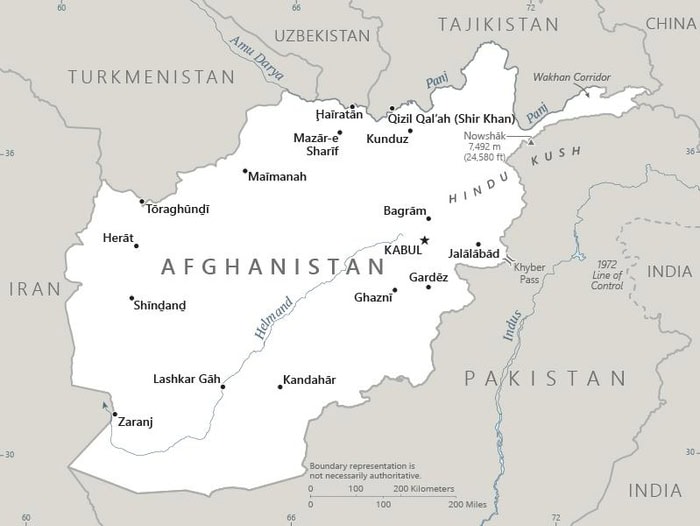
The Central Asian country of Afghanistan has a population of nearly 40 million. It is a landlocked country, bordered by Pakistan to the east and south, Iran to the west, and Turkmenistan, Uzbekistan, Tajikistan and China to the north and north east. Virtually all its citizens are considered to be Muslim, with Christians comprising probably less than 0.1% of the population.
In 1973 the country’s old monarchy was abolished and later in the 1970s there was a Communist coup. Subsequent unrest led to an invasion by the Soviet Union, which lasted for a decade. After the withdrawal of Soviet troops periods of civil unrest continued, and led to the emergence, in the mid-1990s, of the Taliban, a movement with its roots in Islamic madrassas (schools) in Pakistan. In October 2001 the United States of America invaded Afghanistan to remove the Taliban from power, after it had refused to hand over Osama Bin Laden, believed to be the orchestrator of the September 11 terrorist attacks on the US. A new governmental structure and constitution was eventually established in 2004, with the name of the Islamic Republic of Afghanistan.
In 2021 NATO announced a process of withdrawing troops from the country. Soon after this the Taliban launched a fresh offensive against the Afghan government, quickly re-establishing control over the vast majority of the country, which is now known as the Islamic Emirate of Afghanistan.
What it means to be a Christian in Afghanistan
Voice of Persecuted Christians believes Afghanistan to be one of the toughest places in the world to be a Christian. There are no public church buildings in the country. Believers are very few in number and have to meet in secret at all times. Christians – be they converts, ethnic Christians, or Christian workers from outside the country – face the on-going threat of physical violence. Anyone who converts to Christianity from Islam faces the real risk of being killed.
It should be emphasised that this was the situation Christians were living in even before the more hard-line Taliban regained control of the country in 2021; the 2004 constitution having been built upon a strict Sunni interpretation of Islamic law.
However, following the dramatic events during the summer of 2021 there have been reports of Christians fleeing from cities to more remote areas in Afghanistan, to escape the advancing Taliban. Some are said to have received death threats.
Persecution
In the past missionaries to Afghanistan and aid workers have been murdered for their Christian witness. Voice of Persecuted Christians’s partners for Afghanistan say that the intimidation of Christians is ever-present in the country, due not only to hard-line groups like the Taliban, but also because of the close association of Islam with an Afghan nationalism and ethnic identity.
With Christians existing in such small numbers, and with the church being permanently underground, providing good biblical teaching and discipleship is a real challenge. In particular, teaching that includes the issue of suffering for one’s faith is vital.
Some Christians are understood to have fled the country, ahead of the Taliban’s rapid advance, in the summer of 2021. The borders with Pakistan and Iran have been natural escape routes for those seeking to flee. However, many Christians were not able to escape and now the borders are controlled by the Taliban.
Voice of Persecuted Christians work
Voice of Persecuted Christians’s partners for Afghanistan seek to support underground believers in the country both in discipleship and in outreach, through projects titled Operation Matthew and Operation Angel.
This highly sensitive work is done through radio programmes, audio and visual materials and other printed materials. Follow-up, by phone, SMS text or email, is provided for those who respond – whether Christians or enquirers. Bibles and portions of Scripture are produced and distributed. Some of these – whether for discipleship or evangelism – are provided via text or memory cards. This work has been steadily growing. In recent years, our partners report, the demand for their materials has been at a level not seen previously. Afghan believers and enquirers currently living outside of Afghanistan are also impacted.
Many of those who respond are not believers and some express opposition to the gospel. Our partners produce culturally relevant materials that seek to answer such enquirers’ questions, remove common misunderstandings about the Christian faith and so draw people closer to Christ.
The vision of Voice of Persecuted Christians’s partners is to see Christians in Afghanistan grow in their faith and to be able to develop healthy, accessible fellowships where they can share their faith, disciple other Afghan Christians and make a positive contribution to the wider Afghan society.
With many Afghan Christians being forced to flee, another Voice of Persecuted Christians partner has been working to receive many Afghan Christians in Brazil, where they are being cared for, encouraged in their faith and integrated into Brazilian life.